Germany’s transport network is dense, punctual by global standards, and designed to move people efficiently between cities and into the countryside. For a visitor, the key is knowing which mode fits each leg of the journey and how to pay for it without surprises. This guide lays out the options from arrival to last-mile, with practical trade-offs and cautions.
Arrival Airports
Most long-haul visitors arrive at Frankfurt am Main (FRA), Germany’s busiest hub, or Munich (MUC). Both have direct train stations under the terminal. Berlin’s Brandenburg (BER) is smaller but well-connected by regional and intercity trains. For budget flights or specific regions, consider Düsseldorf (DUS), Cologne/Bonn (CGN), Hamburg (HAM), or Stuttgart (STR). Smaller airports like Nuremberg (NUE) or Leipzig/Halle (LEJ) serve fewer routes but offer faster ground access. Check train connections before booking: some airports have direct ICE (Intercity-Express) service; others require a regional train or bus into the city centre.
Intercity Travel: Trains, Buses, and Flights
Trains
Deutsche Bahn (DB) operates the high-speed ICE network linking all major cities. Book tickets early on bahn.de or the DB Navigator app for discounted Sparpreis fares. For example, Frankfurt to Berlin (4–4.5 hours) costs €18–€60 if booked ahead, versus €100+ at the counter on the day. Regional trains (RE, RB, IRE) are slower but cheaper; they accept the Deutschlandticket (€49/month) and are included in many state-level Ländertickets for day trips. Trade-off: ICE is fast and comfortable but expensive last-minute; regional trains are economical but can add hours. Always validate your ticket before boarding in regional trains (stamp it in the blue machine) – ICE tickets are pre-validated.
Buses
FlixBus and a few smaller operators cover routes trains skip, often at half the price. For instance, Berlin to Munich by bus takes 8–9 hours (versus 4 hours by ICE) and costs €15–€30 if booked early. Buses drop you at city-centre stops or peripheral stations; check the exact stop on the operator’s map. Caveat: buses can be delayed by traffic, and comfort varies.
Domestic Flights
For long routes like Hamburg to Munich (700 km), flying can save time if you include security and transfer. Lufthansa, Eurowings, and Ryanair operate frequent shuttles. However, train travel from city centre to city centre often matches or beats total door-to-door time for distances under 500 km. Caveat: check luggage restrictions and airport transfer costs.
Local Public Transport
Every German city has an integrated network of U-Bahn (subway), S-Bahn (suburban rail), trams, and buses. Tickets are zonal: city centre zones (e.g., Berlin’s AB zone) cover most sights; outer zones (C) add airports or suburbs. Buy single tickets, day passes (Gruppenkarte for groups), or multi-day city cards that include museum discounts. Key tip: always buy a ticket before boarding – vending machines are at stations and accept cash, EC card, or credit card. Validation (stamping) is mandatory for paper tickets; digital tickets bought via apps like DB Navigator or local transit apps (e.g., MVV in Munich, VBB in Berlin) are valid upon purchase and do not need stamping. Fines for riding without a valid ticket are €60–€100.
Payment and Apps
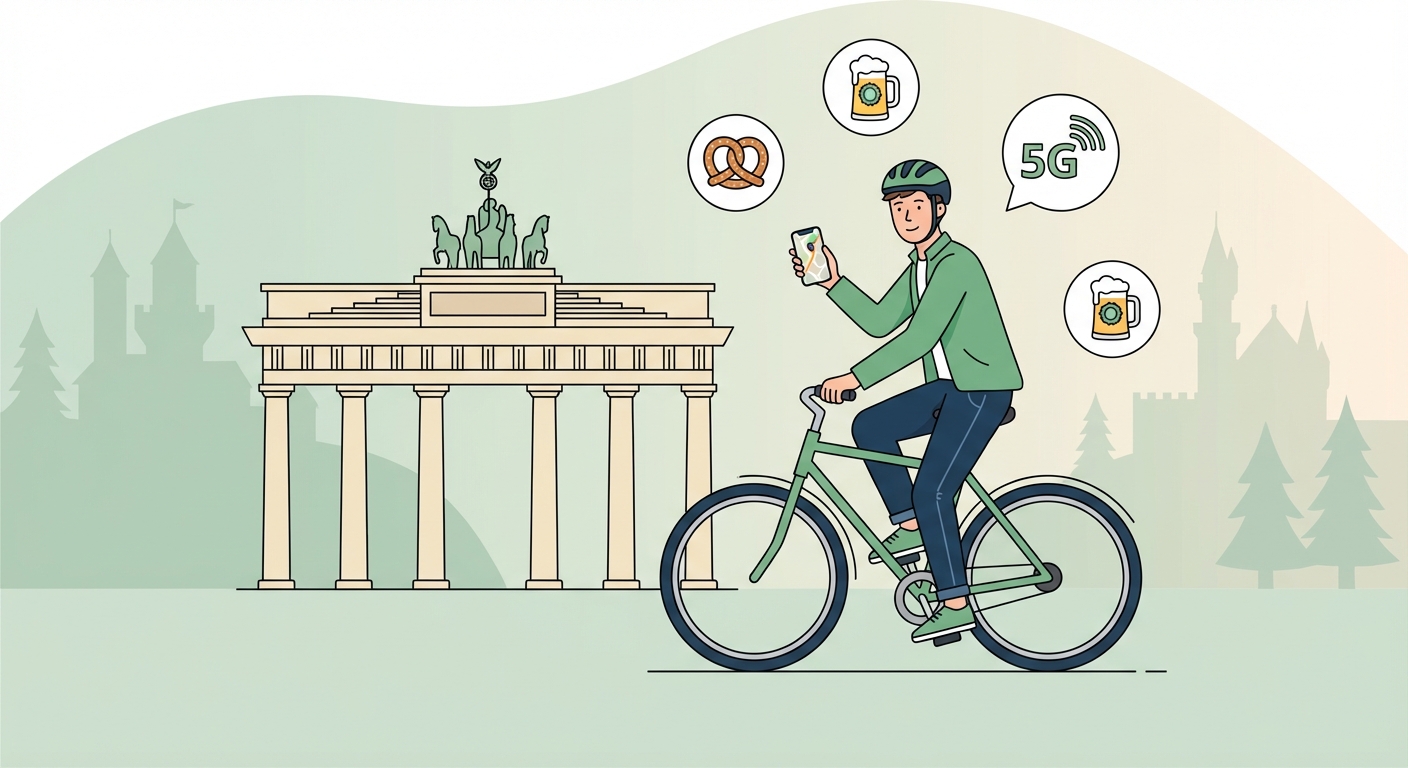
Most transit apps accept credit cards, PayPal, or direct debit. For spontaneous travel, use contactless payment at station gates (where available) or buy a paper ticket. Caution: many vending machines do not accept €50 or €100 notes; carry €5–€20 notes and coins. For regional trips, the DB Navigator app is essential: it shows real-time connections, platform changes, and allows mobile ticket purchase. Mobile data: to use these apps without roaming charges, arrange a Germany eSIM before travel or at the airport – it gives you reliable local data for navigation and ticket apps.
Taxis and Ride-Hailing
Taxis are metered and widely available at ranks or via apps like Free Now. Flagging one on the street is possible but less common. Fares start at €3.50–€5 and charge €2–€3 per kilometre. A 15-minute ride within a city centre typically costs €12–€20. Trade-off: taxis are convenient for late-night or heavy luggage, but expensive compared to public transport. Ride-hailing (Uber, Bolt) operates in most cities but is often pricier than taxis on short trips and may have longer wait times outside city centres. Caveat: surge pricing applies, and drivers may not accept credit cards – confirm payment method before starting the ride.
Driving Trade-Offs
Renting a car gives flexibility for rural areas, the Romantic Road, or the Black Forest. Highways (Autobahn) have no general speed limit, but congestion around cities is common. Key costs: rental €30–€80/day, fuel €1.80–€2.00/litre, tolls (none on public roads, but some tunnels charge €2–€8), and parking €2–€5/hour in city centres. Many city centres have Low Emission Zones (Umweltzonen) requiring a green sticker (Feinstaubplakette) – rental cars usually have it, but verify. Trade-off: driving is faster for off-rail destinations but stressful in cities with narrow streets, tram tracks, and limited parking. For a week-long trip covering multiple cities, trains are usually simpler and cheaper. Caveat: winter driving requires winter tyres (mandatory in snowy conditions) and possibly chains if heading to the Alps.
Accessibility Cautions
Germany’s public transport is improving but not uniformly accessible. Major ICE trains have wheelchair spaces and accessible toilets; request assistance at least 24 hours ahead via DB’s Mobility Service (free). Many U-Bahn stations have lifts, but older stations (especially in Berlin and Munich) may have gaps or no lift – check the station’s accessibility profile on the DB app or local transit website. Regional trains often have steps, and platforms may lack tactile guidance. Caveat: bus drivers are trained to deploy ramps for wheelchair users, but not all stops have raised kerbs. In smaller towns, cobblestones and narrow pavements can challenge mobility aids. A good practice: call ahead or use the mobility-impaired filter on transit apps to plan step-free routes.
With careful planning, Germany’s transport system rewards visitors who match the mode to the route. Book trains early, validate tickets, carry small cash, and always check app-based alternatives for the last mile.